Research Development
Helping to grow research capacity, collaboration, and competitiveness
Looking for Information?
What Is Competitive Intelligence?
Competitive Intelligence (CI) is the ethical, structured analysis of information to support better research decisions. In Research Development, CI helps turn information into insight so faculty can better understand sponsors, funding programs, and the research landscape before committing significant time to a proposal. CI focuses on specific questions and decisions, not just information gathering.
CI support follows a consistent approach:
- Clarify the question and decision context
- Analyze relevant information, with awareness of limitations
- Translate findings into insight, not just observations
- Deliver concise, decision‑focused outputs
What Does CI Support?
The CI pillar focuses on core activities that directly support faculty research planning and proposal development.
1. Finding Funding Opportunities
CI supports faculty awareness through:
- Targeted Alerts and curated opportunity lists
- Customized funding searches with Pivot Database
- Creating ongoing searches for faculty to be notified of new relevant opportunities
The focus is on relevant, aligned opportunities, not broad or generic listings.
2. Internal and External Research Data Requests
CI supports data requests related to UCF research activity, including:
- Institutional descriptions and reports
- Awards data and trend analysis on sponsors or programs
- Research-funding related trends and forecasts
These insights help inform strategic decisions and proposal planning.
3. Honorific Awards
CI supports faculty honorific awards by:
- Identifying relevant honorific award opportunities
- Providing background on sponsors and selection patterns
- Supporting strategic planning for nominations
This work focuses on information and insight, complementing broader recognition efforts.
4. Data Integrity and Research Analytics
The CI team supports data quality and consistency across UCF research analytics by:
- Identifying gaps or limitations in available data
- Suggesting improvements to data resources for improved analysis and reporting
- Ensuring analyses are transparent and appropriately contextualized
This ensures CI insights are reliable and well‑understood.
How is CI Useful for Faculty Researchers?
Faculty can use CI to:
- Understand what a sponsor is likely to fund
- See how competitive proposals are positioned
- Compare their work to peer institutions
- Identify strengths, gaps, and opportunities
- Reduce uncertainty when deciding whether and how to pursue an opportunity
The goal is actionable insight, not more information.
PI Handbook
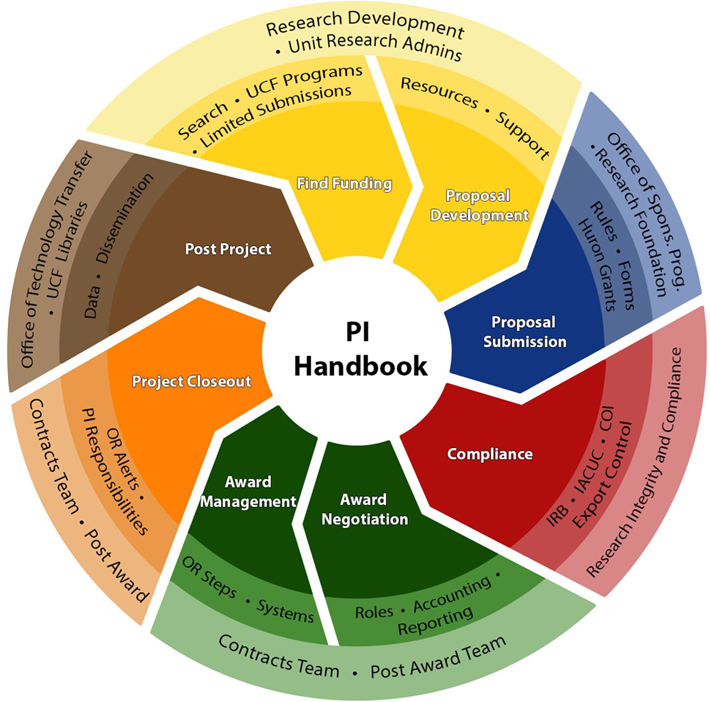
The PI Handbook has been created to provide a quick resource for the information needed to submit your research proposals and compliantly conduct your research. We have organized the handbook according to each step of the research lifecycle – Find Funding, Proposal Development, Proposal Submission, Compliance, Award Negotiation, Award Management, Project Closeout, and Post Project. We provide links to materials including process maps, forms, contacts, procedures, and research web portals.
Keep in mind that only the Office of Research (OR) can submit a proposal. Always consult your unit research administrator if you have questions not clearly addressed in this handbook. We hope you will find this handbook useful. If there are materials we are missing, contact us at resdev@ucf.edu.
(last updated June 2026)
Find Funding
The Research Development (RD) Team can help researchers identify potential funding and prepare competitive proposals. RD coordinates Limited Submissions for UCF, internal programs for the OR, and can assist faculty with funding opportunity searches. The Research Development (RD) team provides faculty with tools, individual support, and group workshops to help the UCF community identify potential funding opportunities
- Website of Research Development Team
- Search for Funding with the Pivot Database: This database includes current and recurring funding opportunities from international, federal, state, and private sponsors.
- Targeted Alerts: You can subscribe to these weekly funding opportunity alerts matching strategically identified UCF research areas to relevant search criteria.
- Internal/Partnership Programs: To support and encourage research endeavors of UCF research faculty, the Office of Research offers a variety of internal and partnership funding opportunities.
- Limited Submissions: These are external funding opportunities that restrict the number of proposals an applicant or institution may submit to a particular solicitation.
- InfoReady: This submission portal is used to coordinate the UCF Limited Submission program as well as several Internal Programs throughout the year.
- Contact LimitedSub@ucf.edu with any questions about Limited Submissions.
For more information, please contact: resdev@ucf.edu
Proposal Development
The Research Development (RD) Team helps researchers identify potential funding and prepare competitive proposals. RD can provide a variety of proposal support to faculty, working in collaboration with unit research administrators.
- New Faculty Workshop Series: This series of workshops provide an overview for faculty on each of the units at Office of Research that will assist them with their research.
- Federal Agency Pitch Circles: This program will help prepare faculty to share their refined pitch with a federal agency program manager.
- NSF CAREER Mentoring Program: For faculty preparing to submit or resubmit to NSF CAREER.
- Office of Research Faculty Mentoring Program: UCF researchers are paired in a mentoring relationship to increase the probability of success in securing external research grant funding.
- Targeted Alerts for New and Early Career Researchers
Proposal Development – Support
The Research Development (RD) Team can assist with proposal planning, preparation, review feedback, informational resources, and more.
- Proposal Support available to UCF Faculty
- Proposal Assistance: We can provide assistance with proposal requirements, planning, collaborators, coordinating documents, supplemental sections, and more.
- Competitive Intelligence: Our goal is to enhance UCF competitive advantage in proposals submissions and future funding opportunities through analysis of past award trends and award details.
- EARLIER: We can provide integrated proposal support on large, complex opportunities using a process called EARLIER.
- Research Resources Available via UCF Research Cyberinfrastructure
Proposal Development – Review
Proposal review services available to UCF Faculty:
- Planning/Reboot: Discussing goals and prior feedback to help plan for a new submission.
- Copyedit: Addresses grammar, formatting, grant writing best practices (e.g., organization, phrasing), RFP and sponsor guidelines, and review criteria.
- Peer: Coordinated, discipline-specific technical review (internal or external)
Note: Office of Research final review for submission and unit-level required processes also apply. RD works within the timing of those deadlines related to the review(s) requested.
Proposal Development – Large Project Support
EARLIER – Pre-Award Shared Services and Research Development have established EARLIER, the UCF Office of Research’s comprehensive approach to Large, Interdisciplinary, and Complex Proposal Submissions with a Significant University-wide Impact. Our primary focus is to reduce administrative burden in submitting large proposal efforts at UCF. We will work in consultation with faculty, department heads, deans, and directors to determine the level of engagement necessary for each proposal or project.
Proposal Development – Resources
The Research Development (RD) Team can assist with proposal planning, preparation, review feedback, informational resources, and more.
- Proposal templates (created based on the specific funder and RFP)
- Sample proposals (maintained library and can seek other samples as needed)
- Team building tools (for interdisciplinary efforts)
- Funder Toolkits (to learn more about funders and their priorities/history)
- Competitive Intelligence (funder history, institutional data, and more)
Proposal Development – Outreach
The Research Development (RD) Team provides information and resources throughout the year by offering a variety of workshops to UCF researchers. The team also facilitates collaborations between UCF researchers/partners to increase the amount of proposals submitted on behalf of UCF.
- New Faculty Orientation: Overview of teams and support across the UCF Office of Research
- UCF Research Support: These workshops provide in-depth details for UCF faculty on resources and services available to support them with their research.
- Agency-Specific Workshops: Insights from awardees and experts on: NSF, DOD, NIH, and more.
- Special Events: Networking, symposia, bootcamps, and program officer campus visits.
- Past Workshops: See slides, recordings, and resources on a variety of past topics.
For more information, please contact: ResDev@ucf.edu
Proposal Submission
The Office of Sponsored Programs (OSP) is the Pre-Award team within the UCF Office of Research. They have the tools, resource, and support needed to assist the UCF research community with review and submission of sponsored research proposals. The Office of Research is the only office vested with the authority to submit and sign research proposals and contracts on behalf of the University of Central Florida.
Office of Sponsored Programs – OSP
- Register investigators in agency submission systems (NSF Fastlane, eraCommons, NSPIRES, etc.)
- Review solicitations
- Review proposals under 5 Day Rule process
- Officially submit all proposals, including subawards, as directed in UCF Policy 4-214
- Coordinate with other offices if necessary due to unusual requirements
For more information, please contact: OSP@ucf.edu
UCF Research Policies and Procedures
- 4-202.2Human Research Protections
- 4-209 Export Control Policy
- 4-210 Distinguishing Gifts from Sponsored Awards
- 4-211.1 Research Misconduct Policy
- 4-214 Proposal and Acceptance of Sponsored Awards for Research and Development
- 4-215 Use of Research Space by Third-Parties and UCF Employees for non-UCF Purposes
- 4-504.3 Reporting a Potential Conflict of Interest or Conflict of Commitment in Research
Proposal Submission – Guidelines and Information
- Proposal Submission Guidelines – OR Guidelines for submitting proposals. Note: All LOIs, white papers, and pre-proposals that include a budget must be entered into Huron as pre-proposals.
- Guide for Budget Preparation: Everything you need to create a budget for your project – from calculating personnel costs to fringe benefits, travel, and more.
- Institutional Information and Facts (F&A Rates, Fringe Benefit Rates): Important information to assist you in writing proposals such as Facilities and Administrative Costs (F&A) also known as Overhead and Indirect Costs, Fringe Benefit Rates, Travel, Tuition, etc.
Proposal Submission – 5-Day Rule Process
- Pre-Day 1 – Work with your local Research Coordinator to prepare to submit
- Day 1 – Submit by 8am with good draft of scope of work.*
- Day 2 – Returned with comments from initial review.
- Day 3 – Corrections and finalize scope of work.
- Day 4 – Submit final form by 8am for final review and submission.
- Day 5 – Sponsor deadline date.
Note: Failure to submit a full proposal on-time will be declined and permission will have to be sought through your ADR to VPR. PI’s College and School may have earlier internal deadlines.
For more information, please contact: OSP@ucf.edu
Proposal Submission – UCF Research Foundation (UCFRF)
Research Foundation makes sure your contracts, grants, and projects are managed in a way that ensures compliance and flexibility. UCFRF should be considered for any awards, including contract and grants, donations, conference and event accounts, sponsorships, and economic development initiatives.
- 501(c)(3) Non-Profit Organization
- Separate legal entity from UCF, but a Direct Support Organization and instrumentality of UCF
- The Research Foundation has its own FEIN, DUNS, and State of Florida tax exempt certificate numbers
- Managed by a Board of Directors
- UCF’s President, Provost and BOT appoints designees to serve on the Research Foundation Board
- Manages and supports contract & grant projects, intellectual property, research sponsorships, donations, and economic development activities
Contacts, resources, tools, and forms are available at the UCFRF website.
Please contact the UCF Research Foundation for more information.
Proposal Submission – Forms
- Policies and Procedures
- Office of Sponsored Programs – Forms for Proposal Submission
- HURON Grants – Forms for Proposal Submission
- Office of Sponsored Programs Organizational Chart – includes contact information
Proposal Submission – Huron Grants
- Reference Guides (sign in using UCF SSO)
- Video Tutorials (sign in using UCF SSO)
- Reference Guide – How to Manage Ancillary Reviews – Reference guide that describes how to manage (add, submit, etc.) ancillary reviews on proposals, awards, and award modifications. (VIDEO)
- Reference Guide for Department Reviewers – Reference guide describes how to complete this review on a proposal. (VIDEO)
- Reference Guide for the Research Community – Reference guide for the UCF research community (PIs, Department Administrators, etc.) that describes how to create a proposal, how to complete a budget, etc. (VIDEOS) (sign in using UCF SSO)
For more information, please contact: OSP@ucf.edu
Compliance
The Office of Research offers a variety of teams and tools to assure research conducted at UCF adheres to regulatory guidelines and meets the highest standards of responsible conduct.
Program & Financial Compliance
- Time & Effort Reporting (ECC): Huron’s Employee Compensation Compliance (ECC) is a system is designed to help comply with the provisions of UCF’s Time and Effort policy, federal policy , NIH Salary Limitation on Grants, and other relevant agency policies.
- Office of International Collaboration and Export Control: Striving to educate and conduct research in harmony with export control laws and regulations.
- Facility Security: Providing support to our customers to safeguard classified information by delivering security training/education and awareness in accordance with the National Industrial Security Program in support of national security.
- Institutional Review Board (IRB): The IRB Committee established to protect the rights and welfare of human participants involved in research. (more links follow)
- Office of Animal Welfare (IACUC): IACUC is responsible for oversight and evaluation of the University animal care and use program, its procedures and facilities to ensure that they are consistent with the recommendations of the Guide, AWR, PHS Policy, and IACUC Policies.
For more information, please visit: https://www.research.ucf.edu/compliance.html
Ethics & Integrity
- Responsible Conduct of Research (RCR): Preserving the Public Trust in Science through the Responsible Conduct of Research and fostering an environment of integrity and honesty in all research endeavors.
- iThenticate: iThenticate is a web-based service designed to help researchers ensure the originality of their written work.
- Research Conflict of Interest (COI): Serving to preserve the integrity by mitigating conflicts of interest in order to protect research subjects and maintain the independence of research results.
For more information, please visit: https://www.research.ucf.edu/compliance.html
Office of Animal Welfare (IACUC)
IACUC (Institutional Animal Care and Use Committee) is responsible for oversight and evaluation of the University animal care and use program, its procedures and facilities to ensure that they are consistent with the recommendations of the Guide, AWR, PHS Policy, and IACUC Policies.
For more information, please contact: iacuc@ucf.edu
Institutional Review Board (IRB)
The UCF Institutional Review Board is responsible for the protection of human subjects in research studies. The IRB reviews and monitors biomedical research involving human subjects in accordance with FDA regulations. IRB approval is necessary to conduct human subject research.
- IRB Membership Representation
- Meet the IRB Team
- Getting Started
- FAQs
- Information for Research Participants
For more information, please contact: irb@ucf.edu
Award Negotiation & Setup
The Office of Research is the only entity authorized by UCF to receive, issue, negotiate and sign research agreements (i.e., contracts, grants, amendments, modifications) with a sponsor. The Office of Research will negotiate all terms and conditions of agreements in accordance with UCF policies and guidelines.
Next Steps for Setup
Congratulations! Here are next steps after notification of an award:
- PI contacts unit research administrator and Office of Research regarding the award notice.
- Award Negotiation occurs via Office of Research (OR).
- After OR approval, Award/Acct setup in Huron Research Suite (HRS)
- PI completes Departmental Authorization List (DAL)
- Huron Deliverables are set (you will get routine reminders from HRS)
- PI begins hiring project staff, project preparation, and purchasing, as applicable.
Note: When the Office of Research receives a notice of grant award or completes negotiations on a contract and the award is fully executed, this fully signed award document becomes the basis for issuing an Awarded Funding Report (formerly Report of Grant/Contract Award-Form 650). If the PI has not received an awarded funding report but has had agency contact indicating that a project has been funded, the PI should contact the Office of Research.
Once an Awarded Funding Report is generated, the PI will receive an e-mail from the Office of Research. This e-mail will contain general information about the award such as the agency, project title, account number, etc. A web address will be provided in the e-mail for access to Office of Research’s server. From here, the award and other documents can be viewed and printed as necessary. The PI will also receive any agency specific guidelines necessary to administer the project. All materials should be carefully reviewed to ensure compliance with all award requirements.
Official award documents include:
- Official award notices
- Contracts
- Letters of Intent
- Final Budget
- Export Control documentation
- Official correspondence concerning award issues
- Amendments and/or change orders
Office of Research retains all original, signed legal documents. Should the PI receive originals of such legal documents, they should be forwarded immediately to the OR.
Resource Links:
- Types of Awards
- Award Negotiation
- New Award Acct Set-Up
- PI Responsibilities
- Workflow Process after Award Notification (sign in using UCF SSO)
- How to Complete Department Edits for Award Setup – Tutorial detailing steps departments will need to complete for award setup in Huron
For contact information, please visit www.research.ucf.edu/for-researchers/post-award/
Award Management
Designated Office of Research personnel are UCF’s official contacts with sponsors/agencies. They are authorized to communicate with sponsors on all administrative matters (e.g., compliance with proposal guidelines, policy issues, all aspects of contract and grant agreements, amendments, modifications, no-cost extensions, and budget transfer requests).
Frequently-Requested Information
- PI Responsibilities
- Expenditures
- Subcontracts
- Budget/Cost Transfers
- Reports/Deliverables
- Subaward Setup / Modification Requests – All subaward setup (or modifications) requires the Unit (PI or Dept.) to submit an HRS Award Modification Request (AMR).
- No-Cost Extensions – Overview from the Office of Research
- Award Management – Huron Grants Videos and Reference Guides for Unit Research Admins (sign in using UCF SSO)
For contact information, please visit www.research.ucf.edu/for-researchers/post-award/
Project Closeout & Post-Project
At project closeout, the Office of Research is required to submit final administrative materials (invoice, fiscal and patent reports, etc.) within the “standard” 90 days after the project end date. The timeframe may change if a sponsor has other requirements.
Award Closeout – 60 to 90 Days Prior to Project End Date
- Approximately 60–90 days before a grant ends, the Office of Research will send an automated message to the Principal Investigator (PI) via email (reportmaster@mail.ucf.edu). This message includes a list of steps needed for an orderly grant closeout.
- PI Responsibilities at 60–90 days prior to the grant end date
Award Closeout – 90 Day Period After a Project Ends
- During the first 60 days after a grant ends, costs (e.g., payroll, late orders) may still post to the grant.
- During this time: The PI and department may process cost transfers to correct errors or address over-expenditures. Once all final expenditures are determined, and financial reports are submitted to the sponsor, the grant will be officially closed.
- PI Responsibilities 90 days after the grant end date
For more information, please visit: www.research.ucf.edu/for-researchers/post-award/awardcloseout/
Post Project
After your project is finished and award closeout is completed, consider if and where your public-facing research data or results will remain available, whether you should explore potential for technology transfer, and what comes next for your research.
Office of Technology Transfer (OTT)
The Office of Technology Transfer (OTT) brings discoveries to the marketplace through intellectual property protection, marketing and licensing processes and connects UCF researchers with companies and entrepreneurs to transform innovative ideas into successful products. UCF has hundreds of innovations ranging from diagnostics to displays, sensors to simulators, nano tech to clean tech, and many more. Our Technology Locator can help you find the solution that’s right for your business.
- Services
- Management of intellectual property
- Strategic transfer of inventions to marketplace
- Negotiation of partnership agreements
- Formation of spinout companies
- Helpful Links
Please Contact TT for more information or visit: https://tt.research.ucf.edu/
Data Storage and Dissemination
- OR GRIT Team – Available to discuss options for long-term server or cloud storage of data.
- STARS Repository – UCF’s Showcase of Text, Archives, Research & Scholarship exists to publicize, disseminate, and provide ready access to works by, for, and about the University of Central Florida. Administered by the UCF Libraries, STARS is available to host and promote research, creative activity, and institutional outputs to…
- Ensure persistent access to your work
- Increase discovery of UCF scholarship and creative endeavors
- Foster scholarly collaborations with colleagues
- Discover open access materials and projects created by UCF authors
- Allow you to share your work while retaining your copyright. If you own the copyright to your work, the copyright for materials uploaded to STARS remains with you.
- Support researchers’ data sharing effort. View the STARS Researcher FAQs.
- The Research Communications Team shares research and scholarship news to the UCF community, partners and the public.
- UCF Today shares stories written by UCF authors from each corner of the campus.
RESOURCES

UCF Facts
Details about UCF enrollment and broad characteristics, activities, and impacts. Updated annually.
Scholar Expertise Portal
Searchable tool to find researchers at UCF based on research keywords, with results showing relevant scholarship, awards, projects, and collaborations.
UCF Rankings Information
See UCF national rankings for various programs and areas.
Interactive Facts Dashboards
Searchable tool to drill down into a large number of data sources about UCF, including student characteristics (down to program level and spanning enrollment, retention, and graduation) as well as other data about UCF.
Funder Tool Kits
Public Access Initiative
Federal agencies partner to support the White House’s Open Science mandate that by 2025, all peer reviewed publications and associated data resulting from federally-funded research be made freely available upon date of publication. The NSF Public Access Repository has peer-reviewed papers and other products of NSF-funded research.