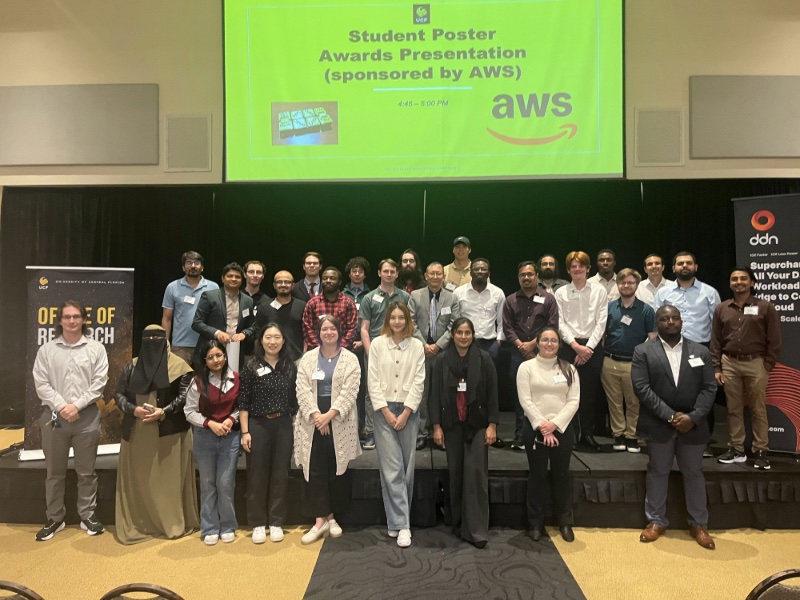
Third-annual symposium explored the tools and technologies supporting modern scholarship across a variety of disciplines.
A daylong symposium hosted by the Office of Research’s Cyberinfrastructure department featured presentations about how advanced computing powers research across disciplines – and can help researchers tackle big challenges such as kidney cancer and storm surge.
The third-annual Research Computing Symposium was created with the hope of fostering collaborations between faculty, students, research technology professionals, and industry partners.
The event included a keynote panel that examined opportunities and challenges for digital twins involving data integration, cybersecurity and other infrastructure needs that support complex modeling and simulation. Between faculty research presentations and a discussion with industry partners, the event presented opportunities for researchers to explore new and expanded partnerships with industry.
The daylong symposium featured 16 invited talks, 24 speakers, and 29 poster presentations, The event also included a research poster competition that recognized three student-faculty teams on topics ranging from healthcare, physics and engineering.
The breadth of projects presented throughout the day demonstrated how research computing is becoming essential across a growing range of disciplines. Presentations explored applications in artificial intelligence, healthcare, coastal research, materials discovery, neuroscience, engineering, digital twins, energy resilience, genomics, quantum information science, humanities and qualitative research.
Digital Twins Take Center Stage
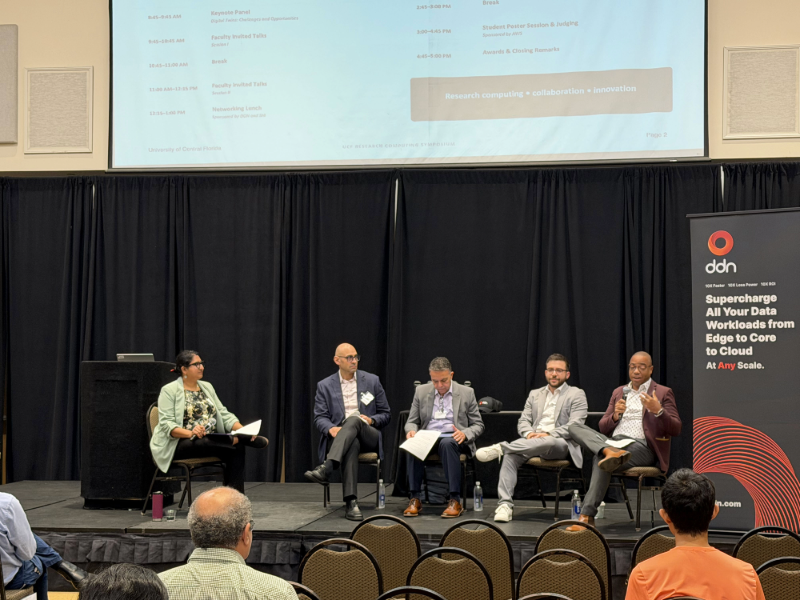
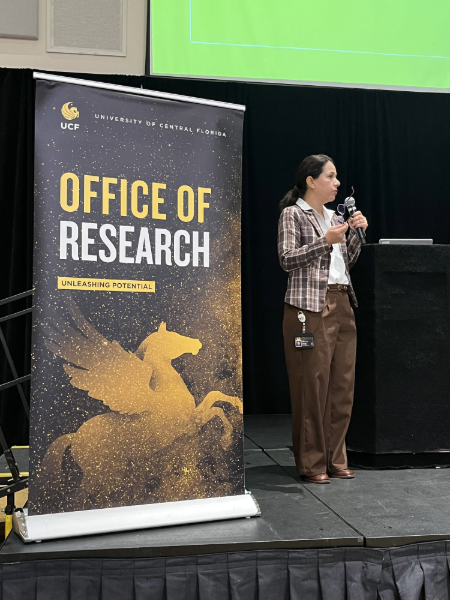
The symposium opened with remarks from Chad Macuszonok, assistant vice president for Research Technology, followed by a keynote panel, “Digital Twins: Challenges and Opportunities,” moderated by Shafaq Chaudhry, director of cyberinfrastructure.
The panel featured UCF assistant professors Soheil Sabri, Sean Mondesire, and Minas Pantelidakis and Professor Ghaith Rabadi, who explored how digital twins are being applied in areas ranging from urban planning and advanced manufacturing to artificial intelligence and cyber-physical systems.
The panelists examined the challenges and opportunities of digital twin technologies, including data integration, interoperability, cybersecurity, model fidelity, governance and the significant computational resources needed to synchronize physical and digital environments in real time.
Computing Powers Research Across Disciplines
Research presentations throughout the day demonstrated how advanced computing infrastructure is enabling new discoveries across a wide range of fields.
From multimodal medical AI for kidney cancer, to deep learning and national supercomputing resources for coastal storm surge reconstruction, UCF researchers shared examples of how high-performance computing and AI are supporting their research. Other presentations explored adaptive digital twins for industrial applications.
The program also highlighted cloud-hosted AI for power-outage resilience, large-scale genomic analysis, quantum photonics, and quantum algorithms. Researchers demonstrated how cloud and AI technologies can support work in areas such as historical handwriting transcription, clinical AI, and qualitative research.
“What was particularly exciting this year was seeing the breadth of research represented at the symposium. Researchers across UCF are using high-performance computing, AI, cloud technologies and other advanced computational resources to tackle increasingly complex research questions across disciplines,” says Chaudhry.
Together, the presentations illustrated the growing importance of advanced computing infrastructure to research across fields ranging from medicine and engineering to the humanities.
Student Poster Competition Celebrates Emerging Researchers
Student researchers played a prominent role in the symposium, presenting 29 posters that highlighted their innovative applications of advanced computing across disciplines.
“The poster competition is one of the highlights of the symposium because it gives our students an opportunity to showcase their research, engage directly with faculty and peers, and communicate how advanced computing is helping them address challenging research problems,” says Fahad Khan, Research Technology engineer and co-organizer of the student poster competition. “The quality and breadth of this year’s poster presentations really demonstrated the creativity and talent of UCF’s student researchers.”
The 2026 Student Poster Competition recognized three teams:
- First Place: Jose Gabriel Gonzalez Nunez and Associate Professor Laura Brattain for “A Unified Evaluation of Tooth Segmentation Models and Diffusion-Based Synthetic Data Augmentation in Panoramic Dental Radiographs”
- Second Place: Abdul-Hafiz Alabi and Associate Professor Shyam Kattel for “Electrochemical Nitrate Reduction to Nitrogen gas on Transition Metals Surfaces”
- Third Place: Md. Nafees Fuad Rafi and Associate Professor Samiul Hasan for “A Graph Learning Approach for Network-Wide Real-Time Traffic Flow Prediction During Wildfire Evacuations”
The competition complemented the invited talks by providing students an opportunity to share their work with researchers from across the university and demonstrate how advanced computing is helping address complex scientific and societal challenges.
Building a Research Computing Community at UCF
Now in its third year, the UCF Research Computing Symposium serves as a campus-wide forum for researchers to share their work, exchange ideas, showcase innovations and explore the tools and technologies supporting modern scholarship.
The 2026 symposium exemplifies the expanding role of research cyberinfrastructure across UCF, from high-performance computing and GPUs to cloud platforms, artificial intelligence, large-scale data analysis and emerging quantum technologies.
The symposium was sponsored by DataDirect Networks (DDN) and SHI, while Amazon Web Services (AWS) sponsored the Student Poster Competition.
The Office of Research Cyberinfrastructure supports UCF researchers with resources including high-performance computing, cloud computing, research data storage, research software and consulting.